Exhibitions
E-motion to cohabit
Exhibition: E-motion to cohabit
Locations: Galleria d’Arte Moderna Palazzo Forti, Verona
Date: October 9 – November 28, 2010
Opening: Friday, October 8, 2010 at 12.00
Curators: Aurora Fonda, Radmila Iva Janković
Artists: BridA (SI), Vesna Bukovec (SI), Lada Cerar (SI), Marijan Crtalić (HR), Igor Eškinja (HR), KOLEKTIVA (SI), Andreja Kulunčić (HR), Vlado Martek (HR), Marjetica Potrč (SI), Marijana Vukić (HR), Metka Zupanič (SI)

About the exhibition:
This year we are continuing to exchange ideas with the contemporary art world in the countries of East Europe. After the last edition, focussed on Bosnia-Herzegovina, this year Aurora Fonda from the Centro Espositivo Pubblico Sloveno, Venice, and Radmila Iva Janković, from the Museum of Contemporary Art, Zagreb, will present a selection of works by twelve artists from Slovenia and Croatia.
We will be presenting a part of that fragmentary culture which in the past century was known as Mitteleuropa or Middle Europe: a geographical mass considered as a paradigm for western post-modern culture and characterized by the eclecticism and fluidity of its values and by its opposition to the two East/West monolithic blocks.
Ever since antiquity mankind has felt the need to build and delimit areas so as to help his perception of the surrounding world. Effectively, confines do not exist in nature apart from various insurmountable natural barriers. So it is obvious that the human mind cannot imagine a world without physical and mental structures which, in some way, impose limits on our actions and, in exchange, offer us a sense of security.
Art too is an example of this contradiction; in fact, the physical structure of works of art create a space within a space, whether they are installations or simple pictures: these, paradoxically, claim to go open the viewers’ mind to a wider awareness by expanding beyond the exhibition space itself.
Starting from these concepts, we have aimed at constructing a show that, taking into account the emblematic situation of the Italian Northeast which is hosting it, turns its attention to the contemporary art scene in two bordering countries: Slovenia and Croatia.
Here we are faced with a series of economic, social, cultural, and linguistic differences and limits which coalesce to create a fluid situation that can be grasped by observing the works on show.
From a creative point of view, noting the differences and the dialogue between them means becoming aware of the concept of limits seen from a new perspective: that of artists who can display a fascinating discovery to us, one where a single individual’s language can become the spokesman for the specifics of his origins. That kind of tension which, instead of being a defect, can actually be a strong point which is manifested in the differences in the interpretation of a subject that these artists have to face every day: the body, communications, the territory, space, and social concerns.
This exhibition has been made possible by the collaboration between ArtVerona, the City of Verona’s cultural office, the Galleria d’Arte Moderna Palazzo Forti, the A+A gallery, and the Gallerie Costiere, Piran; it has been sponsored by the Slovenian Ministry for Culture, the Consulate of the Slovenian Republic in Trieste, and Zagreb City Council.
Aurora Fonda
The exhibiton is part of the accompanying program of ArtVerona 2010.
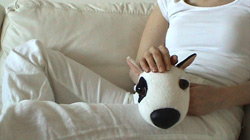
I am participating with series of drawings Positive Illusion and video It Will Be OK.

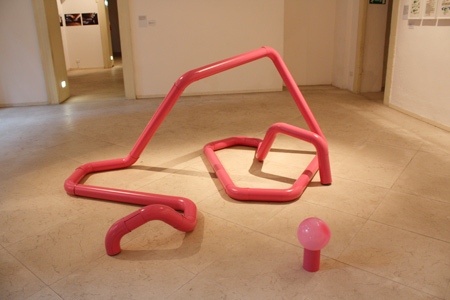
KOLEKTIVA (Vesna Bukovec, Lada Cerar, Metka Zupanič) is participating with a new sculpture Lost in Translation.
—
Photos from the opening:


19. dokumentART, European Film Festival for Documentaries
Exhibition: 19. dokumentART, European Film Festival for Documentaries
Locations: Neubrandenburg (DE) / Szczecin (PL)
Date: October 8-13, 2010
videoART
October 9-13, 2010, Kino Obserwatorium, al. Wojska Polskiego 90, Szczecin
Curator: Antoni Karwowski
Artists: Paulo Abreu (PT), Michał Brzeziński (PL), Vesna Bukovec (SI), Zlatko Cosic (BA/US), Alec Crichton (UK), Rainer Gamsjäger (AT), Pieter Geenen (BE), Takahiro Hirata (JP), Joanna Polak (AT), Noah Klersfeld (US), Lenka Klimešová (CZ), Ulf Kristiansen (NO), Wai Kit Lam (HK), Rudolfas Levulis (LT), Kai Lossgott (ZA), Johann Lurf (AT), Gillian McIver (UK/CA), Charlotte Merino (FR), Matias Montarce (ES), Stina Pehrsdotter (SE), Mikey Peterson (US), Janna Riabowa (DE), Avi Rosen (IL), Peter Rosvik (FI), Sam Smith (AT), Simone Stoll (DE), Arthur Tuoto (BR), Robbert Weide (NL)

About the screening:
Experimental videos of 29 artists from all around the world will be screened as part of 19th European Film Festival for Documentaries dokumentART.
www.dokumentart.org/en/event/397
www.officyna.art.pl
I am participating with with 3 videos: Endless Game, Consumer Culture and I can create positive change.


SIMULTAN FESTIVAL #6
Exhibition: Past Continuous. Future perfect. SIMULTAN FESTIVAL #6, Timisoara
Locations: Teatrul Maghiar (str. Alba Iulia nr. 4), Sinagoga din Cetate (str. Marasesti nr. 6), Daos Club (Splaiul Titulescu nr. 5, intrare de pe str. Jiul)
Date: September 30 – October 2, 2010

About the festival:
The Simultan Festival is an annual festival for video, media art, experimental music and a/v projects.
The festival wishes to sustain and to stimulate the creative ways of the most modern visions of perceiving and recording the cultural realities in contemporary art. It presents the current processes and the way in which technology and society give rise to new forms of artistic expression by using the new media.
Based on a different theme every year, the festival presents video art projections, live performances, installations, lectures.
www.simultan.org
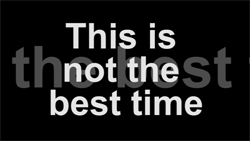
I am participating with videos It Will Be OK and Personal Advice.
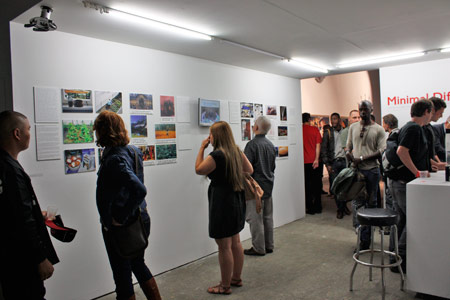
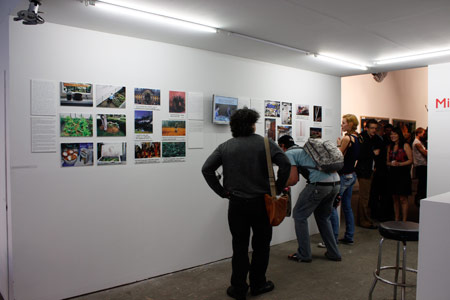
Minimal Differences
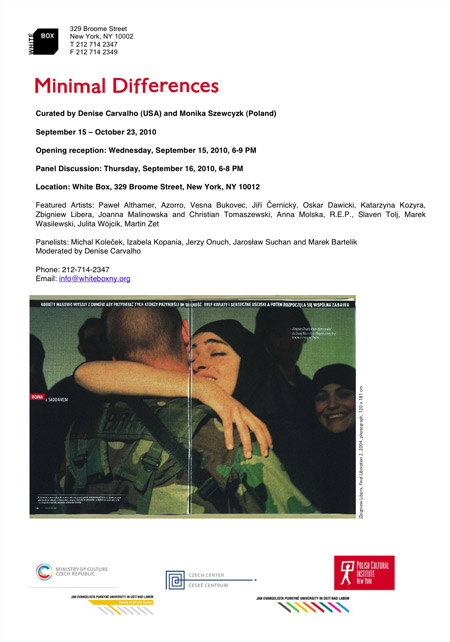
Exhibition: Minimal Differences
Location: White Box, 329 Broome Street, New York, NY 10012
Date: September 15 – October 23, 2010
Opening Reception: September 15, 2010, 6 – 9 pm
Panel Discussion: September 16, 2010, 6 – 8 pm
Curators: Denise Carvalho, Monika Szewczyk
Artists: Paweł Althamer, Azorro, Vesna Bukovec, Jiři Černický, Oskar Dawicki, Katarzyna Kozyra, Zbigniew Libera, Joanna Malinowska & Christian Tomaszewski, Anna Molska, R.E.P., Slaven Tolj, Marek Wasilewski, Julita Wójcik, Martin Zet
Panelists: Michal Koleček, Izabela Kopania, Jerzy Onuch, Jarosław Suchan, Marek Bartelik
Moderator: Denise Carvalho
About the exhibition:
“Central Europe,” the umbrella term favored among formerly “Eastern” European countries, is defined by membership, not geographical position. Although called ‘central’, Poland, Czech Republic, Estonia, Slovenia, Slovakia, et al, remain in the periphery of continental Europe, having within their borders great differences in regard to language, religion, ethnicity, economics, and politics. These differences become ironically ‘minimal’ in light of the new economic demands that enable their survival in the global economy. This catch-22 leaves Central Europeans with little choice but to reflect themselves as stereotypes of ‘otherness’, as virtual realities, an otherness within, like two parallel worlds living together, even though only one is real. Postcolonial societies over the centuries have chosen to inhabit the very stereotypes they hoped to overturn; only by “being” could they eventually subvert their own half-identities, somewhere between the colonizer and the colonized. “Minimal Differences” explores the two sides of this ironic self-definition: one, which has become ‘central’, therefore losing all the privileges of subversion, resistance and rebellion of its previous state of difference and otherness; and the other, still a memory of itself, a self-stereotype humoring itself as a parallel reality, a phantom-limb, itching and hurting, but no longer real.
More:
galeria-arsenal.pl
www.whiteboxny.org
I am participating with the project Contemporary Art for Parents

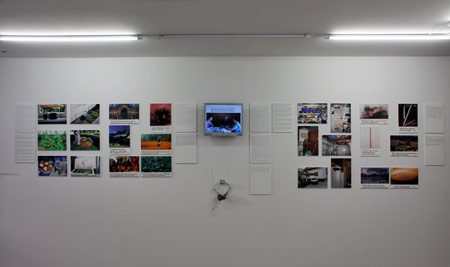
With Vesna Bukovec’s video and interactive piece, Contemporary Art for Parents (2002), this idea of meaningful meaningless is turned on its feet, as art becomes as meaningful as a new ideology that needs to be learned by parents and people of earlier generations. In Bukovec’s work, she is the narrator, the interrogator, and the ruler. She creates the laws of either understanding or misunderstanding art. Bukovec applies a didactic method in which misunderstanding art is the most effective way to actually understand it. It is also interesting to consider how the communication of contemporary art is its most valuable tool to sustain language autonomy from an art market that reduces ideas into desirable objects or marketing strategies. The historical trajectory of Art has gone from being an object of mediation between beauty and function to an object of language, from object to subject matter; it has become an advocate for the dying dialect of the intellect of an elite-turned-margin of the global world. In today’s world of consumerist functionality, the subject matter of contemporary art is a dead language, but its object is mostly alive. How to explain to parents and the mainstream lay person that the art object’s concept is still what drives it into the economic circuit? This is an ongoing task. Vesna Bukovec’s work is also about the difficulties in sustaining communication on the most basic levels, here paralleled to the level of the stereotypes in central Europe. The artist tries giving a hands-on explanation to her parents about the most important issues in contemporary art, looking at market, history, institutions, browsing through texts, tasks that prove to be quite difficult. The issue of being didactic, which contemporary art avoids, ironically becomes the main tool for achieving a common ground.
From the text Minimal Differences by Denise Carvalho
—
Photos from the opening


Word for Word, without Words
Exhibition: Word for Word, without Words / Dobesedno brez besed
Location: City Art Museum (MGML), Mestni trg 5, Ljubljana
Date: September 15 – October 30, 2010
Artists: Marina Abramović in Ulay, Maria Ångerman, Vesna Bukovec, Attila Csörgő, Zvonko Čoh, Edvin Dobrilovič, Domestic Research Society, Igor Eškinja, Tomaž Furlan, Kostja Gatnik, Albert Heta, Damijan Kracina, Siniša Labrović, Giovanni Morbin, Ivan Moudov, Alban Muja, Miki Muster, Arjan Pregl, Provokart, Marija Mojca Pungerčar, RIGUSRS (The Researcs Institute for Geo-Art Statistics of the Republic of Slovenia), Hinko Smrekar, Ive Tabar, Slaven Tolj, UNIKUM (University of Klagenfurt, Cultural Center)
Artifacts and documents from collections: Museum and Galleries of Ljubljana, National Museum of Slovenia, Celje regional Museum, Slovene Ethnographic Museum
Exhibition concept and selection of works: Alenka Gregorič and Domestic Research Society (Damijan Kracina, Alenka Pirman, Jani Pirnat)
Curator: Alenka Gregorič
Expert associates: Erika Kržišnik, Mateja Podlesnik, Janez Polajnar, Petra Zaranšek, Bernarda Županek
About the exhibition:
What happens if we divest language of figurativeness and start taking it literally, word for word? With a number of selected idioms from the Slovenian language as our points of departure we have explored linguistic directness and presented it in an interdisciplinary show. Underpinning the project is our everyday experience of using idiomatic expressions in written and spoken language.
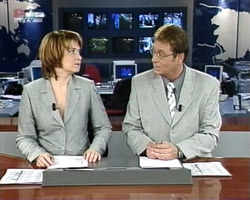
I am participating with a video Important News, 2003
—
Recent
Archive
Search
Artists
Galeries and Institutions
- Alkatraz Gallery
- ArtFem.TV
- Culture.si
- Hiša kulture v Pivki
- International Centre of Graphic Arts (MGLC)
- Museum of Modern Art (Moderna galerija)
- Odprta zbornica za sodobno umetnost
- Outcasting
- P74 Center and Gallery
- Photon Gallery
- SCCA-Ljubljana
- Simulaker
- Škuc Gallery
- The Bring In Take Out Living Archive
- The Gallery of Fine Arts Slovenj Gradec (Koroška galerija likovnih umetnosti Slovenj Gradec)
- Umetnostna galerija Maribor (UGM)